


Interpretation Response #PI-25-0001
Below is the interpretation response detail and a list of regulations sections applicable to this response.
Interpretation Response Details
Response Publish Date:
Company Name: Louisiana DNR
Individual Name: Steven Giambrone
Location State: LA Country: US
View the Interpretation Document
Response text:
Mr. Steven Giambrone
Office of Conservation
Department of Energy and Natural Resources
617 North Third Street
Baton Rouge, LA 70802
Dear Mr. Giambrone:
By letter dated January 31, 2025, the Louisiana Department of Natural Resources (LDNR) submitted a request for a written regulatory interpretation from the Pipeline Safety Hazardous Materials Administration (PHMSA), Office of Pipeline Safety (OPS). Specifically, LDNR asked OPS whether the Federal gas pipeline safety regulations in 49 CFR Part 192 apply to a natural gas pipeline in St. John the Baptist Parish, Louisiana. OPS concludes that regulations in Part 192 apply to the pipeline for the reasons discussed below.
Background
The pipeline described in LDNR's request is a lateral that connects to the Gulf South transmission pipeline system in Louisiana, which is owned by DuPont de Nemours, Inc. (DuPont), and a petrochemical facility in St. John the Baptist Parish, LA. The pipeline was previously operated by Gulf South as a part of its interstate natural gas pipeline system, but operatorship of the line was transferred to the owner, DuPont, in 2024. The line currently serves DuPont with natural gas, most of which is consumed by DuPont, but some is "redelivered" to a petrochemical facility owned by another entity who has a lease within the facility.
The letter states the location of the pipeline is primarily on DuPont property as shown in Figure 1 below. The line crosses one road, DuPont Construction Road, which is a public road providing access to the DuPont facility. It also crosses railroad tracks at two locations. The pipeline specifications are as follows: 8.625" OD x 0.322" WT, Grade B, ERW. The maximum allowable operating pressure (MAOP) of the pipeline is 735 psig with an operating pressure of 285 psig. When Gulf South was operating the pipeline, they determined the line was in a Class 3 location due to the proximity of a residential area and a school in relation to the pipeline. Operation at MAOP generates a hoop stress that is 28 percent of the Specified Minimum Yield Strength (SMYS). It is DuPont's intention to lower the MAOP of the pipeline such that it falls below the 20 percent SMYS threshold described in the definition of a transmission line at § 192.3.
The letter also states there are two above-ground pressure regulator stations associated with this line. The first is at the connection with the Gulf South transmission pipeline. At this location, natural gas enters a regulator station (on DuPont property), where pressure is lowered from 1,016 psig to 285 psig. At the second station or "meter station," the pressure is reduced further to 200 psig and the gas is metered. The meter station is where Gulf South previously ended their operatorship of the pipeline, and DuPont has always operated the line downstream of the meter station location.
The letter also indicates that inside of the facility, DuPont piping delivers gas to various areas for its own use and consumption. In addition to DuPont's own use, DuPont delivers gas to Denka Performance Elastomer (Denka) petrochemical facility within the boundaries of the DuPont facility to be utilized by Denka for their operations. There is at least one meter within the DuPont facility to measure the gas delivered to Denka, who is invoiced for its gas usage. The DuPont facility is a Process Safety Management (PSM) facility and the pipelines within the facility are treated as such. Additionally, DuPont states that the pipeline in question, from the tap with Gulf South transmission pipeline to the meter station, is also covered by Dupont's PSM plan.
Relevant Regulations
OPS has determined that the following regulations are relevant in responding to LDNR's request for interpretation:
§ 192.3 Definitions
Distribution center means the initial point where gas enters piping used primarily to deliver gas to customers who purchase it for consumption, as opposed to customers who purchase it for resale, for example:
(1) At a metering location;
(2) A pressure reduction location; or
(3) Where there is a reduction in the volume of gas, such as a lateral off a transmission line.
Distribution line means a pipeline other than a gathering or transmission line.
Master Meter System means a pipeline system for distributing gas within, but not limited to, a definable area (such as a mobile home park, housing project, or apartment complex) where the operator purchases metered gas from an outside source for resale through a gas distribution pipeline system. The gas distribution pipeline system supplies the ultimate consumer who either purchases the gas directly through a meter or by other means, such as by rents.
Pipeline means all parts of those physical facilities through which gas moves in transportation, including pipe, valves, and other appurtenance attached to pipe, compressor units, metering stations, regulator stations, delivery stations, holders, and fabricated assemblies.
Service line means a distribution line that transports gas from a common source of supply to an individual customer, to two adjacent or adjoining residential or small commercial customers, or to multiple residential or small commercial customers served through a meter header or manifold. A service line ends at the outlet of the customer meter or at the connection to a customer's piping, whichever is further downstream, or at the connection to customer piping if there is no meter.
Transportation of gas means the gathering, transmission, or distribution of gas by pipeline or the storage of gas, in or affecting interstate or foreign commerce.
Transmission line means a pipeline or connected series of pipelines, other than a gathering line, that:
(1) Transports gas from a gathering pipeline or storage facility to a distribution center, storage facility, or large volume customer that is not down-stream from a distribution center;
(2) Has an MAOP of 20 percent or more of SMYS;
(3) Transports gas within a storage field; or
(4) Is voluntarily designated by the operator as a transmission pipeline.
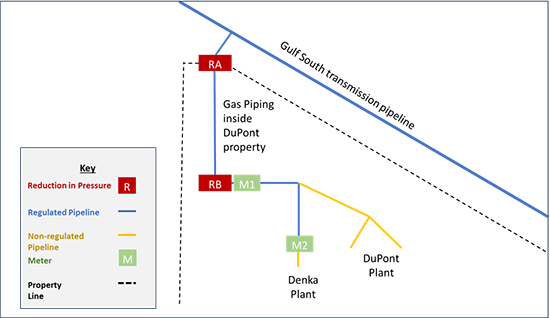
Figure 1.
Analysis
PHMSA's interpretation of 49 CFR Part 192 regarding the questions presented by LDNR are below:
Question 1: Does the jurisdiction of a gas pipeline depend on whether or not it is located on the end user's property? Since DuPont is a consumer of the gas and the gas enters its own pipeline on its own property, does jurisdiction end at that point?
PHMSA Response: In this case, DuPont is the consumer of part of the gas being transported on their property grounds but also sells gas to the Denka plant which is on DuPont property.
Interpretation PI-07-0105 is instructive. In that interpretation, PHMSA considered the jurisdictional endpoint of a lateral pipeline running from a transmission pipeline to an electrical power plant. Specifically, the requester asked if jurisdiction ends at the property line, fence line, first valve on the property, the power equipment, or another location. PHMSA responded: "Assuming the lateral pipeline in question is a transmission line as defined in § 192.3, pipeline safety authority extends to the point where transportation ends, even if this point is on plant property. In many cases, the endpoint is where the lateral pipeline enters the plant grounds, usually at a security fence line. If, however, a measurement meter (or other component necessary to control the pressure or safety of the pipeline) is on the plant grounds, the endpoint would be the meter (or other component, if the component is downstream of the meter)." In DuPont's case, the pipeline delivers gas to meters M1 and M2 (see Figure 1), which are downstream of the property line. Therefore, jurisdiction does not end at the property line.
It is important to understand that even though the pipelines in question in the reference interpretation request refer to a transmission line, the same would apply to a distribution line as well.
Question 2: Does the jurisdiction of a gas pipeline depend on whether or not it is located behind the fencing of an end user's property?
PHMSA Response: Similar to the response to Question 1, in this case there is a continuation of the transportation of gas that extends beyond meter M1 to meter M2 at the Denka plant on the same property grounds.
According to the definition of a service line found in § 192.3, a service line ends at the outlet of the customer meter or at the connection to a customer's piping, whichever is further downstream, or at the connection to customer piping if there is no meter. Jurisdiction of a gas pipeline is a function of the location of the meter, not a property line or fence. This position is reiterated in Interpretation PI-12-0005 which clarified the end point of transportation for a natural gas pipeline feeding two large volume customers was at the meter or pressure control device within the pipeline owner's property, not at the property boundary.
Question 3: Does the fact that DuPont delivers gas (re-sale) to Denka change the jurisdictional determination?
PHMSA Response: Yes. The fact that DuPont delivers gas to Denka (another end user) affects the jurisdiction of the pipeline transporting gas from DuPont's meter (M1) to the meter at Denka's facility (M2). See Figure 1.
The pipeline that transports gas from the reduction in pressure (point RA in the diagram) to the meter (M1) of the DuPont facility meets the definition of a distribution line and is jurisdictional to Part 192. This is because (RA) would be considered a "Distribution Center" in accordance with § 192.3. Dupont's pipeline delivering gas to Denka from meter (M1) to meter (M2) marked in blue in Figure 1, would also be considered a distribution line and is jurisdictional to Part 192. The pipelines marked in yellow in Figure 1 are non-regulated pipelines by the Office of Pipeline Safety because they are customer owned piping used for the consumption of natural gas. Per § 192.3 service line definition, a service line ends at the connection to customer piping if there is no meter.
Question 4: Does the piping downstream of the meter station located outside the facility qualify as a master meter since some of the gas purchased by DuPont is re-delivered for sale to Denka?
PHMSA Response: No. Meter (M1) is not a master meter.
The pipeline system downstream of meter (M1) is owned and operated by DuPont which sells some of the gas to Denka at meter (M2). The pipeline that connects (M1) to (M2) owned by DuPont is a pipeline facility engaged in transportation and is subject to the jurisdiction of Part 192. A "Master Meter System" is defined in § 192.3 as a pipeline system for distributing gas within, but not limited to, a definable area (such as a mobile home park, housing project, or apartment complex) where the operator purchases metered gas from an outside source for resale through a gas distribution pipeline system. The gas distribution pipeline system supplies the ultimate consumer who either purchases the gas directly through a meter or by other means, such as by rents.
The description of the pipeline facilities from M1 to M2 do not meet the conditions of a "Master Meter System" but rather is a pipeline delivering gas to a single petrochemical facility (Denka).
Question 5: Can pipelines required to be covered by PSM plans also fall under DOT regulation?
PHMSA Response: Our regulatory interpretation is limited to the applicability of the Federal pipeline safety regulations. You will need to discuss the applicability of PSM plans with Occupational Safety and Health Administration (OSHA).
If we can be of further assistance, please contact Joe Berry at (720) 601-3577.
Sincerely,
Cameron H. Satterthwaite
Acting Director, Office of Standards
and Rulemaking
Regulation Sections
| Section | Subject |
|---|---|
| 192.3 | Definitions |